
Advocacy for rights of disabled people
On Monday my team was invited to a meeting organised by Sightsavers International. There were representatives of different disability groups and some government officials. The aim of the meeting was to advocate for more sign language interpreters so that deaf people are able to access public services and functions and to decide on actions that will be taken to achieve that goal. I felt that I didn’t have much expertise or insight to offer, but it was very interesting to hear the points made and the promises made by the ministers.
Kabwoya group formation
On Tuesday afternoon my team travelled to Kabwoya (in the next district over, Kikube) for a group formation training session for 13 individuals who have not yet been supported by Sightsavers. The group seemed very pleased with the training, despite the heavy rain that stopped the session half-way through (tin rooves + rain = lots of noise!) and are looking forward to working with us again. Our team was also happy with how the session went as we have been trying to form a youth group since the start of the cycle. We are the first group of ICS volunteers to work with HUDIP (Hoima Union for Disabled People) so lots of our activities have been laying the ground-work for the next cycle and they should be able to work with the Kabwoya group in January.
Active citizenship day
On Wednesday morning two lots of volunteers did their active citizenship day presentations. This is part of the ICS programme where counterpart pairs run a series of sessions based around a topic to do with international development.
Annie and Daniel led discussions about HIV/AIDS and compared the different perspectives of the disease in Western society and Africa. It was interesting that the Ugandans in no way associated HIV/AIDS with homosexuality as we’re used to that misconception in the UK (more so in the past than now). It was also good to find out during a quiz that our pessimistic guesses for numbers of people affected by the disease were higher than the real figures (36.9 million) and a higher percentage of people infected are aware they have the condition (75%).
Then Jacob, Cairinne and I gave a session on poverty, which created surprising conversations within the group. Some of the Ugandans struggled with the concept that poverty also exists in the UK. There is a definite perception here that white people have lots of money and, even if you explain that our wealth is relative because things are much more expensive in the UK and there are people who have very little money, it seems to be a difficult concept for some people to grasp.
Kabwoya game reserve
On Thursday we went for a team outing to Kabwoya Game Reserve to see the wildlife there. However, we did get stuck at the side of the motorway for a few hours waiting for our project officer to help us get into the park. To be fair at least there was a pretty view of a green valley, but the heat was very intense.
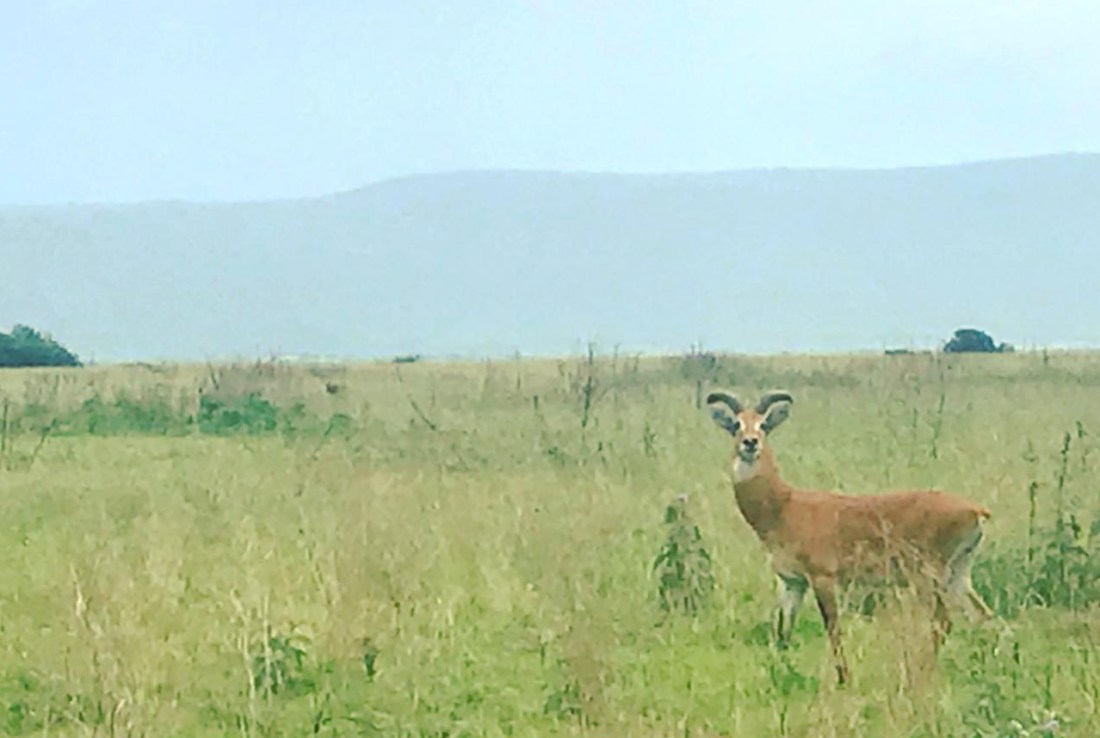
The game reserve itself was great. The scenery was stunning and we saw lots of animals: there were loads of antelope, some half-beasts (similar to antelope but with furrier necks), warthogs and baboons (which were much bigger than I expected). We then had a nice drink in a lodge overlooking the lake from a cliff. The water merged with the sky and seemed to go on forever, the smooth blue broken only by the small black dots of fishing boats way out.
Mzungus in a van
A much less pleasant experience came on Thursday afternoon when we visited ‘the landing site’. This was apparently to see the lake closer up, but it was a very busy fishing village with lots of tiny silver fish frying in the sun (which had a very pungent smell and attracted lots of flies). We did manage to meet the chairman to set up a training session for a women’s group in the town. However, most of the UK volunteers stayed in the van because lots of people crowded around to see the mzungus and it was quite intimidating. They kept calling out, staring, hitting the van (some with hammers), and trying to poke them through the windows (sometimes with sticks).
Livelihoods fair
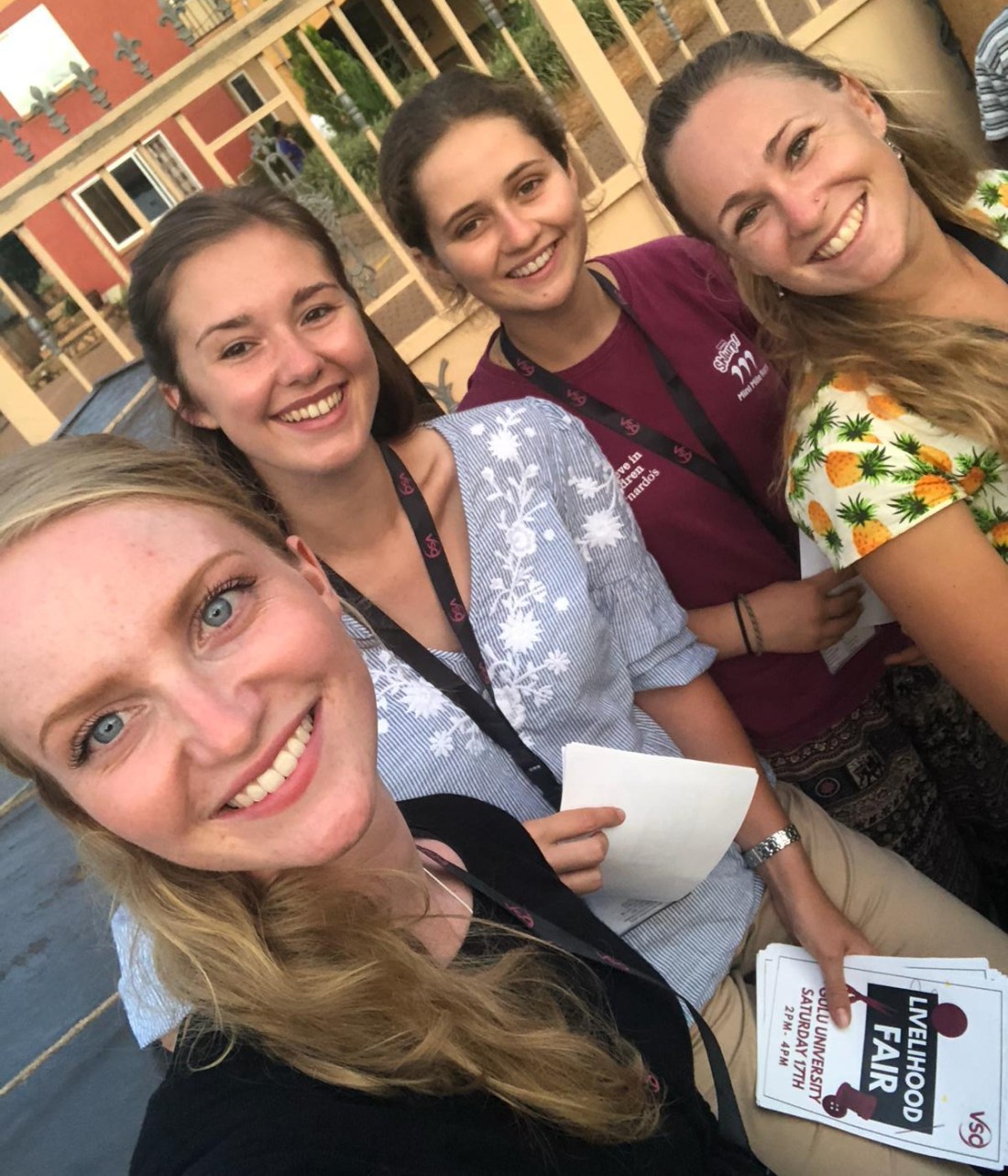
On Friday evening a group of us stood in the back of a truck with a big speaker and banner to promote our livelihoods fair the following day. It was really fun to try and hand flyers to people passing by, but slightly scary to be on a moving vehicle. Daniel from our team made announcements in English and the man in charge of the speaker announced in Runyoro (the local language) apparently saying “Come and see the mzungus”. Although people seemed interested it didn’t help actually get people to the event.
On Saturday everything went surprisingly smoothly: the tents were in place, all the groups we invited arrived on time to set up their stalls and we got the speakers ready. We were just missing people to come and look around! In the end we had to stand on the street and entice passers-by to come and look at the stalls and through this managed to get a fair amount of people. We had invited the groups we work with to display their businesses, sell products, and give people information, as well as the vocational training institutes to inform people about available courses. Although it got off to a rocky start the event was a relative success.
Breakfast Jam
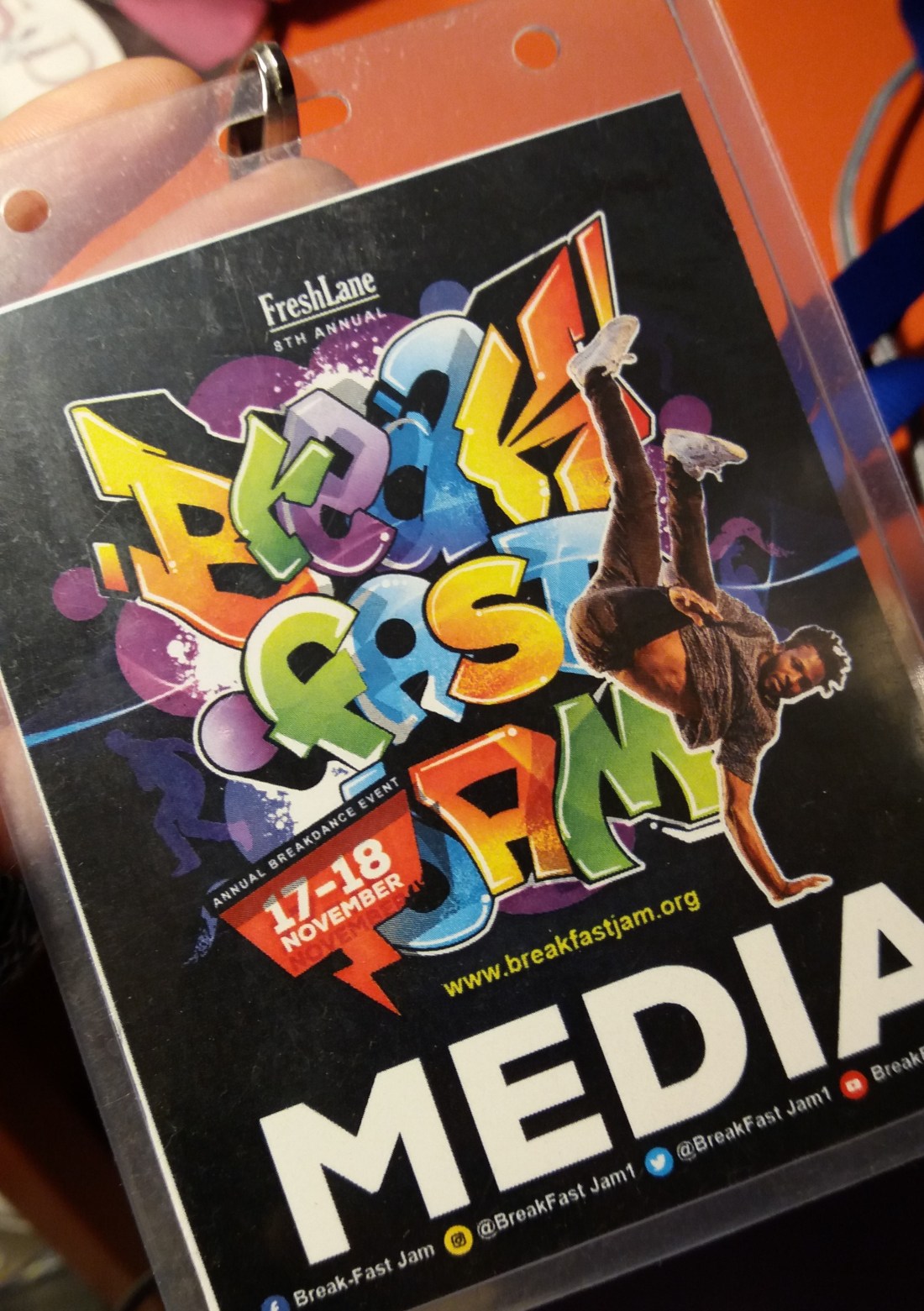
On Sunday I went to Kampala (the capital) with my team leader, Torom, to go to Breakfast Jam – a hip hop dance competition. Torom is a reporter for Humans of Uganda and was invited to photograph and report the event so we both got snazzy media passes (which I felt like an imposter wearing!).
There were lots of reporters and hip (hop) people there (which I most definitely am not) so I felt a bit out of my depth at first, but once the competition got going the atmosphere was so friendly and I loved it! There were a surprising amount of white people there (including DJ Snuff from Ireland) and it was the most diverse crowd I’ve seen since being in Uganda. The structure for the competitions consisted of various dance battles and eliminations where the breakers and poppers showed off their moves.
First there was a kids’ competition, which was very sweet and impressive, and then the women’s final which was called ‘Big girls’. I was surprised to find two of the female finalists were Finnish and one of them won the competition. A judge for the main event was also from Finland so I guess they may have a link with a Ugandan club.
The aforementioned main event is the men’s break dance competition called ‘7 to Smoke’. The premise is that one dancer starts and the other seven stand in a queue to compete in a dance battle. Whoever wins stays and whoever loses joins the back of the queue. It lasts for 25 minutes and whoever won the most dance-offs wins overall. The dancing was so impressive with head stands, spins, flips and many other moves I can’t even name. The winner – Bosa – was insane and is going to represent Uganda at an international competition in Taiwan.
Then there were semi-finals for the popping competition, which was super cool and I loved the bold fashion choices of the competitors, especially the great array of hats. Sadly, we missed the final as we had to get back to Hoima, but I had picked my bet for who would win.
The dance competitions were interspersed with a variety of performances: judges’ showcases, an African drumming band, rappers from the UK and Uganda, a break-dance trio, a teen dance crew, and a very cute little Asian girl who danced with her coach. Lots of people crowded round the dance floor and whooped and cheered the performers with a resounding cry of “No way!” for the best dancers. Even a couple of power cuts didn’t stop the party! It’s one of the best events I’ve been to and I’m so glad I got to go.
Tuesday, 20th November
 Ella's blog
Ella, The Blog is so amazing.
LikeLike
Thanks!!
LikeLike